
Welcome to our Blog

The daily Post

Read our Blog

Five Things That Annoy Customers on Social Media

social media computer content marketing seo facebook twitter social media management

Recently, Sprout Social published their Q3 2016 study on brand behavior on social media channels. One of the best insights of the publication was a series of things that brands do on social media which annoy their customers and followers. While these things may seem small in comparison to major social media gaffes, they slowly erode the relationship between customer and brand, and may lead to an unfollow down the line.

In this article, we’ll discuss each one of these things, as well as how to correct these bad habits to more effectively use social media.

The Promotion Machine

We get it, promotions are important as a sales strategy and make customers’ wallets happy. That doesn’t mean that your social media communications should be an extreme couponer’s dream. The point of a promotion is that it is temporary and rare, motivating the customer to click and take advantage of it in the moment. Too many promotions ruins the novelty and gives the brand an unpleasant, spammy feel.

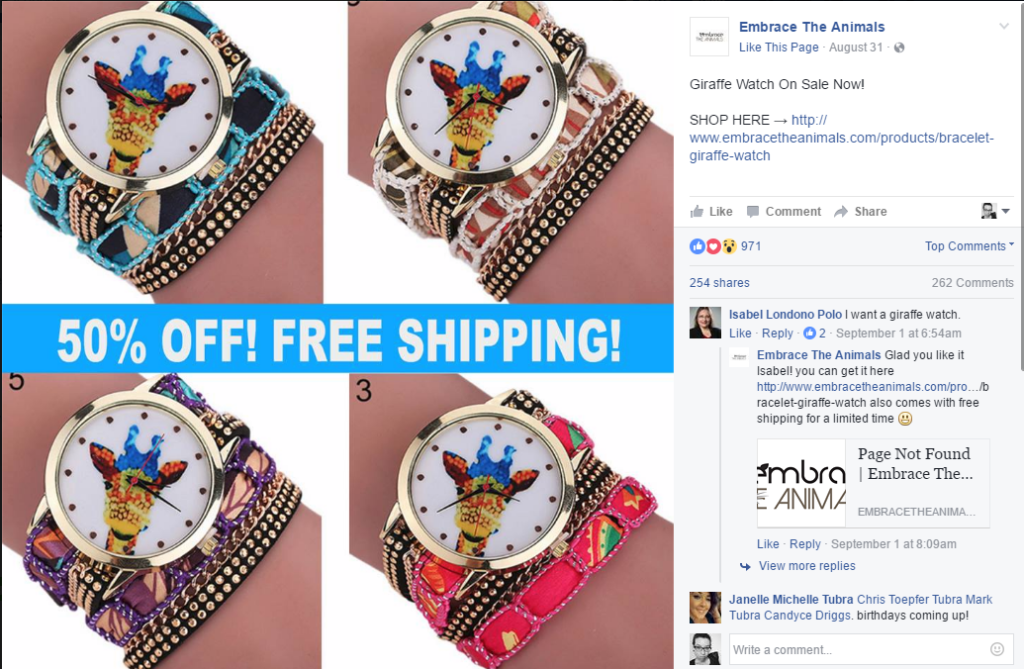
An interesting example of over promotion can be found with Embrace The Animals, an online clothing and accessories shop. Over the course of a single day, Embrace The Animals published ten posts on Facebook promoting their products and offering free shipping. Their products may be great, but hardly any customers will be reaching for their wallets after post number 10.
social media computer content marketing seo facebook twitter social media management

Correct this by: Live by the adage: Less is more. Save your promotions for holidays or special industry focused days (for example, if you’re a pastry shop, this Friday, October 14th is National Dessert Day).

BRB, checking out the ROI of the MKT campaign

Being concise in social media is important (maximize the use of those precious 140 characters), but that doesn’t mean you have to rely on industry acronyms or abbreviations that your audience might not understand. Also, when it comes to slang, trying to be cool by speaking like the young’uns has been uncool since the 1950’s. Your audience is smart, and when you sound inauthentic, the response probably won’t be the best

Correct this by: Stay authentic and clear. Stay faithful to your brand’s voice and tone. Make sure that your audience will understand what you’re trying to say.

A Dull Social Personality

No brand aspires to be like Eeyore, and in a world where brands are constantly competing for customers’ attention, being easy to remember is crucial. Those who assume a safe, neutral personality for their social media content come across as robotic and uninspiring.

Correct this by: Identify and embrace your brand’s voice and tone. Give your audience a reason to engage with you.

Bad Stand-up Night

Laughter is the best medicine, but it can be a disaster if misused. Banter may be common in the stand-up comedy world, but in marketing, the wrong joke can bring negative attention and massive unfollows from your audience.

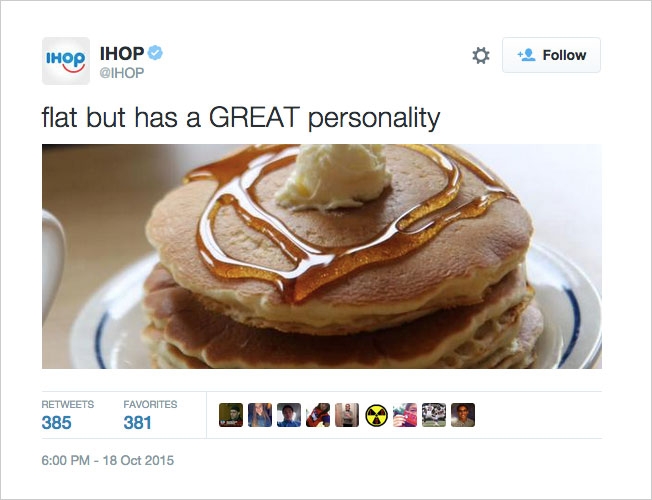
Last year, IHOP fell victim to this when they tweeted an offensive joke, making a reference to their pancakes within the context of women’s breasts. Audience reaction was quick, and the brand was forced to take down the tweet and apologize.
social media computer content marketing seo facebook twitter social media management

Correct this by: Fully digesting ideas. Something might sound funny in your head, but it may actually be terrible. Many writers step away from their content and revisit it with fresh eyes a few hours later, or even the next day. If something sounds too forced, remove it or add some wit.

The Silent Treatment

What is the point of being on social media if you’re not… social? Many brands still make this mistake, opening an account and not doing anything at all. Or even worse, posting on their account often, but without interacting with their followers at all. This is particularly dangerous when it comes to customer complaints or questions, because this can also affect future sales.

Correct this by: Speak up! Set certain times during the day to reply to as many customers as possible in a friendly, human tone.

In conclusion

There is always room for improvement when it comes to social media and interaction with customers. If your brand is guilty of any of these things, take action and correct these issues before your analytics fall apart.


Five Things That Annoy Customers on Social Media

social media computer content marketing seo facebook twitter social media management

Recently, Sprout Social published their Q3 2016 study on brand behavior on social media channels. One of the best insights of the publication was a series of things that brands do on social media which annoy their customers and followers. While these things may seem small in comparison to major social media gaffes, they slowly erode the relationship between customer and brand, and may lead to an unfollow down the line.

Read more

Five Things That Annoy Customers on Social Media

social media computer content marketing seo facebook twitter social media management

Recently, Sprout Social published their Q3 2016 study on brand behavior on social media channels. One of the best insights of the publication was a series of things that brands do on social media which annoy their customers and followers. While these things may seem small in comparison to major social media gaffes, they slowly erode the relationship between customer and brand, and may lead to an unfollow down the line.

Read more

Let Go of These 5 Content Marketing Myths

content marketing myths social media blogging content calendar

“Don’t wear white after Labor Day” is one of the most prevalent fashion myths that is still resounding today. There is no reason why it’s such a preposterous sin to do so, other than the possibility of a rainy day (to avoid stains and see-through surprises). But many fashionistas keep spreading it and obeying it faithfully.

Every industry has its own set of hard to kill myths. Content marketing isn’t the exception, and it’s dangerous. Creating and executing our strategy through old, debunked rules will make our product look old and debunked. Customers are smart and are harder to bait with old-school methods.

Here are five of the most prevalent content marketing myths and how to ditch them once and for all.

Your website is enough

A website is just part of a good digital marketing strategy. Telling people who you are and what you do is not enough to get potential customers to find you. In the highly competitive world we live in right now, brands need to offer a reason to click on their link instead of on the other one before or after theirs. Content marketing, SEO and inbound marketing tools are must-haves for today’s websites if they want to get visits from current and future customers.  

You have to be in all social media channels

As I write this sentence, there are 209 social networking websites listed in Wikipedia. I bet that by the time you are reading this other sentence, at least two more have appeared. It’s simply not possible, or even necessary, to waste your efforts by being in every channel.

We have to be where our audience is.  We don’t even have to be in The Big Four (Facebook, Twitter, Instagram and Snapchat) if our audience isn’t there. Study your customers’ social media habits and be sure to be there when they’re connected.

You have to go viral or bust

Viral, that little word that makes us content marketers go crazy. What was previously associated with terrible things (from the flu to any big pandemic), is now one of the most desired traits for marketers.

I have some news for you: viral isn’t necessarily a good thing.

The key for highly shared content (I like this one better) is to create things that people are genuinely interested in, with no hidden motive, only because they want to educate, entertain or create bonds. We have all seen cases of brands creating something just to cash in on the virality, trying too hard, and getting terrible feedback from it.

The main goal of creating content isn’t fast fame and a short-lived peak of visits, it’s to keep people coming back to your site because they like what you do.

Post all the time, or you will be forgotten

Posting frequency is essential to be seen by your audience. You can’t expect to share one update per month and wait for the RT’s to come out of thin air. But, this doesn’t mean that you have to shower your audience’s timeline with new posts every five minutes. This will definitely lead you to their spam folder.

Look at your analytics and search for trends in your audience. If there’s a big influx on Tuesday at 9a.m., by all means, post at that time to increase the odds that you will be seen. Platforms like Buffer even suggest the best time to share your content, and encourage you to schedule your content at that time.

You can write about anything

This one gets both a yes and a no. Not every topic, in its pure form, is suitable for every brand. Let’s say you have a mobile tech site, and you’re secretly passionate about puppy and kitten cams because baby animals are cute, and people love clicking on them. Maybe writing about pets is boring for your audience; but how about a roundup of cases featuring pets? Or an article about the best tech for your dog? As long as we don’t lose the focus of our main strategy and it doesn’t look forced, you can take elements from almost anything and apply them to your brand.

However, it’s important to determine which subjects are off-limits to avoid harmful controversy and the wrong type of attention. Some current events, such as politics and religion, may be too heavy for most brands. Steer clear from them.

In conclusion

Whether you’re implementing your first content marketing strategy, or you’ve already had some experience, it’s important to review your perspective and make sure that you’re not making mistakes based on outdated rules. Taking calculated risks and focusing on the audience are key factors for content marketing success, so we invite you to get out of your marketing comfort zone and go all in.

Let Go of These 5 Content Marketing Myths

content marketing myths social media blogging content calendar

“Don’t wear white after Labor Day” is one of the most prevalent fashion myths that is still resounding today. There is no reason why it’s such a preposterous sin to do so, other than the possibility of a rainy day (to avoid stains and see-through surprises). But many fashionistas keep spreading it and obeying it faithfully.

Read more

Let Go of These 5 Content Marketing Myths

content marketing myths social media blogging content calendar

“Don’t wear white after Labor Day” is one of the most prevalent fashion myths that is still resounding today. There is no reason why it’s such a preposterous sin to do so, other than the possibility of a rainy day (to avoid stains and see-through surprises). But many fashionistas keep spreading it and obeying it faithfully.

Read more

Four Ways to Master Customer Service for Our Brand

customer service complaint twitter marketing

In the age of social media, customers have all the power. In the good old days, when a customer wanted to complain, they would speak with the manager, or call the 1-800 number on the back of the box. Today, they reach for their smartphone and @the brand while they vent on Social Media. This can be very dangerous for brands, especially as it can trigger a snowball of replies from other customers, causing irreparable damage.

According to SproutSocial, 34.5% of surveyed customers use social media to communicate with brands. This outpaces traditional channels, such as the 1-800 number (16.1%) and person-to-person interaction (just 5.3%). Unfortunately, most brands aren’t as proactive in answering customers’ inquiries in a timely manner – While consumers expect to receive an answer within 4 hours of posting, brands take, on average, 10 hours to reply. This very likely means that most marketing departments are underestimating the power of social media.

How can brands open communication?

It’s possible for brands to create protocols or procedures for tracking conversations around them, and tackle negative feedback as soon as possible. Below, you can see four top tips to confront complaints and bring efficient customer support to your clients.

1. Keep a separate account dedicated to customer service: Another insight from SproutSocial is that brands post an average of 23 promotional messages for every 1 response. A customer may feel discouraged upon seeing the brand’s active posting and lack of response to their complaint.

A way to beat this is to keep a separate handle dedicated solely to customer service, and redirect unhappy users (immediately) to it; not to get rid of them, but to improve response times.

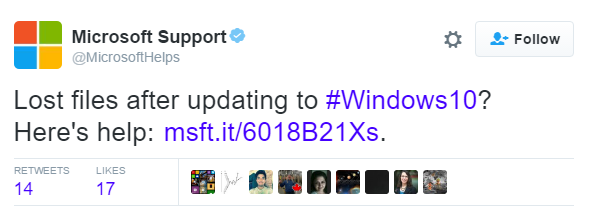
A good example of this is Microsoft: in addition to their regular channel (@microsoft), they have a dedicated account for customer service – @MicrosoftHelps. Besides tending to customers’ issues, they also tweet helpful tips and how-to’s for their products.

Microsoft customer service complaint twitter marketing windows

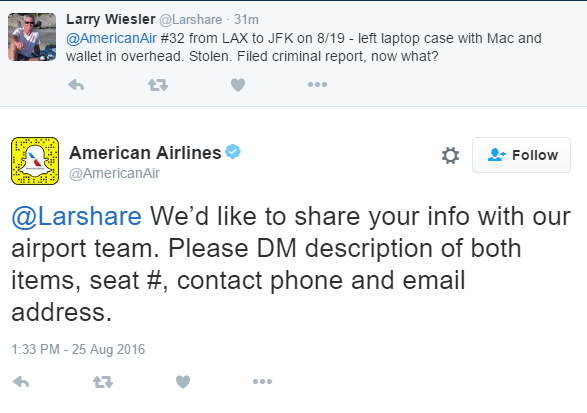
2. Gather all the necessary information: Something worse than ignoring complaints is replying with mistaken or unhelpful information. Customer support teams must have access to all the facts, in order to give the best answer possible.

Companies like American Airlines (@AmericanAir) rely on this type of strategy to address travel inconveniences such as: lost baggage, delays, and cancellations. Reaching out to customers ASAP and keeping the conversation via Direct Message (especially when it comes to sensitive data) is crucial to reducing the traveler’s stress levels and overcome the (figurative) bump in the road.

customer service American Airlines twitter marketing complaint

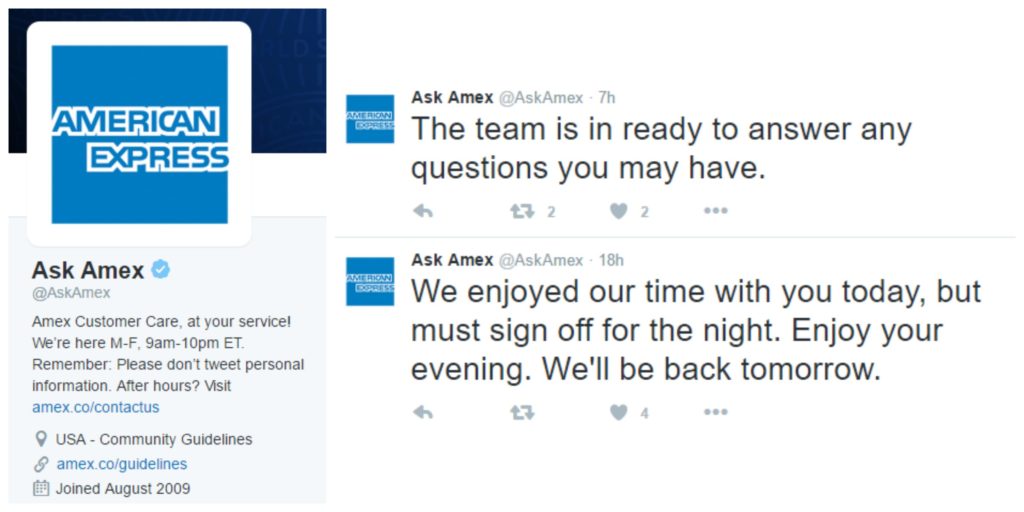
3. Set up “business” hours: The human touch that is necessary in social media also affects community managers and analysts. For some brand categories, it’s not realistic to have a 24/7 situation room for complaints. It’s valid to define business hours for your customer service account, just remember to list them in your bio, in order to set customers’ expectations.

American Express’ customer care channel, @AskAmex, not only displays the account’s working hours, it also directs customers to their website for after hours service, and, very nicely, announces the beginning and the end of their work day with corresponding tweets.

customer service american express amex twitter marketing complaints

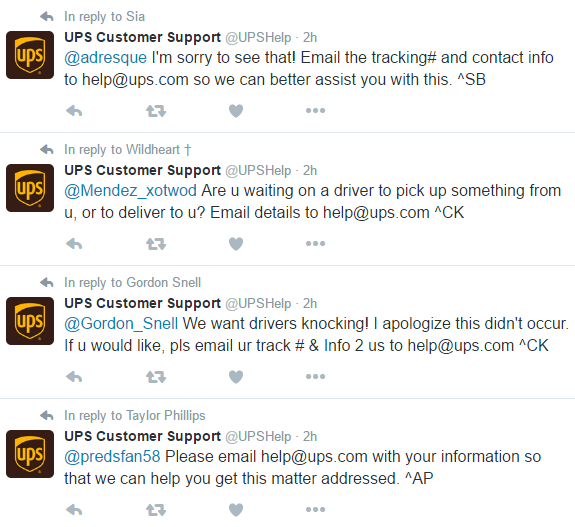
4. You are a human being. Act like one: Just as we despise robotic answers in a customer service hotline, copy-pasting replies may be convenient in a crisis, but it displays lack of empathy and tone-deafness.

Brands such as UPS (@UPSHelp) understand this. Having their representatives “sign” every reply with their initials, reminds customers that there is a human being handling the request on the other side.

UPS customer service twitter marketing complaints

In conclusion

No brand is immune to mistakes in the trenches, and suppressing bad comments is refusing to listen and learn, which is fatal in the long run. The sooner your marketing team develops a great strategy for customer service, the better. Listening and learning from our customers will always pay off.

Four Ways to Master Customer Service for Our Brand

customer service complaint twitter marketing

In the age of social media, customers have all the power. In the good old days, when a customer wanted to complain, they would speak with the manager, or call the 1-800 number on the back of the box. Today, they reach for their smartphone and @the brand while they vent on Social Media. This can be very dangerous for brands, especially as it can trigger a snowball of replies from other customers, causing irreparable damage.

Read more

Four Ways to Master Customer Service for Our Brand

customer service complaint twitter marketing

In the age of social media, customers have all the power. In the good old days, when a customer wanted to complain, they would speak with the manager, or call the 1-800 number on the back of the box. Today, they reach for their smartphone and @the brand while they vent on Social Media. This can be very dangerous for brands, especially as it can trigger a snowball of replies from other customers, causing irreparable damage.

Read more

Presidential slogans, the race for capturing votes

Presidential slogans, the race for capturing votes

It’s safe to say that 2016’s presidential campaign has been one of the most ferocious and controversial electoral campaigns we have seen in many years. From the primaries, we have seen the rise of highly aggressive candidates such as Donald J. Trump and Bernie Sanders, and also subtle attackers like Hillary Clinton. With the Conventions for both parties behind us, these three have been the most memorable candidates, for their efforts in capitalizing on their electorate’s needs through their diverse messages.

Recently, Advertising Age posted two very interesting essays regarding the slogans of Clinton and Trump, the main contenders for the White House. Showing opposite points of view, they highlighted how a well-crafted slogan, along with a powerful marketing campaign are key for winning in November. We salute their effort in giving us an unbiased analysis without any emphasis on their own thoughts on the candidates.

Let’s dig deeper into these phrases and try to figure out what the average voter for either party feels when they read these slogans.

What makes a slogan powerful?

A slogan is a bite-sized storytelling atomic bomb. It must reflect the brand’s purpose, it must be positive, it must be catchy, and most importantly, it must be short. Coming up with a slogan, is a very complex process, since it requires a thorough study of the target audience and its relationship with the brand; it doesn’t come out of thin air.

For politicians, choosing the right slogan can change the future of millions who identify themselves with its message and support it in the polls. No modern strategy, no Snapchat use, no #TwitterChat, and no special-edition voting Pokemon can make up for a terrible slogan. Think about the cultural impact Obama’s 2008 Hope slogan has permeated society in many levels, to the point that we still talk about it.  

Even though the two main candidates on this presidential campaign are very high profile, they too need the power of a good slogan to capture and retain voting audiences nationwide. This goes beyond a pretty sign to hold and wave while the candidate speaks at a rally. A political slogan is a battle cry, it summarizes the ideology of a candidate or party and it makes people want to take action for the future of their nation.

Presidential slogans, the race for capturing votes

Stronger Together

Hillary’s short but clear slogan came just in time for the Democratic National Convention, after a series of not-so-interesting tries. It seemed that her campaign advisors had a hard time finding a catchphrase that would be engaging enough for her electorate, and that would attract opposing and/or indecisive voters by November.

NPR’s Morning Edition recounted how the Democrats’ slogan for this campaign surpassed older versions such as “I’m with her”, which didn’t have enough spark to allure her electorate, in giving a sense of union that many feel is lacking on Donald Trump’s individualistic stance. This was reinforced by Mrs. Clinton herself, when in her speech during the DNC, she stated “Americans don’t say ‘I alone can fix it.’ We say, ‘we’ll fix it together.'”

Another key element for this slogan is the fact that we saw two very strong Democrat candidates (Clinton and Sanders) putting a strong fight in the primaries process, almost to the end. Many Sanders supporters were disheartened when their candidate lost terrain and conceded the candidacy to Clinton, so the crucial point of “Stronger Together” is to offer a hand to these voters, to become allies in the way to the White House.

Make America Great Again

From Day 1 of his campaign for the Republican primaries, Donald Trump has caught the attention of everyone, coming in with a very strong stance and aggressive language. And even if other politicians, have responded with vitriol, it’s very hard to ignore The Donald’s impulsive and ruthless messages.

“Make America Great Again” aims to attract a sector of the electorate that’s looking for a blunt president, in a way trying to bring back the old “America is for the Americans” feelings. Trump’s campaign advisors have managed to capture the emotions of dissatisfied conservatives and capitalize on it through bold proposals that have made ripples through the Republican Party, but have also caught the attention of an important group of voters.

Whether or not this sentiment is translated into votes by November, the shakeup it has caused to the Republican party will be hard to wind down. Even if some voters aren’t sure how would a Trump presidency go through making the country great, they’re willing to stand by him and act.

In conclusion

The slogan, and what it stirs in the electorate, is what makes voters choose one candidate or one ideology over another. In the end, politicians are just another brand looking to capture the support of millions, through emotions and arguments supported by great storytelling. A politician that doesn’t understand this, and that stays strictly rational, will never thrive in the polls.

2016’s candidates have understood this and are focusing the effort of the final months to keep standing by their battle cry to capture as much support as possible. We’re looking forward to witnessing the results of their work in November, and seeing what will be the guiding light for the next four years in our country.